TLDR: Too Long, Don’t Read
The fire damage restoration process involves six key steps: emergency assessment and safety inspection, property securing and stabilization, water removal and drying, smoke and soot cleanup, odor neutralization and sanitization, and final repairs or full reconstruction. Coast View Plumbing & Restoration handles every step for homeowners and businesses across Greater Los Angeles, 24 hours a day, 7 days a week.
Experiencing a house fire or structural fire is one of the most disorienting emergencies a property owner can face. Once the flames are out, the real question becomes: what happens now? Understanding the fire damage restoration process helps you know what to expect, what to ask for, and how to move forward with confidence.
Professional fire restoration is not simply cleaning up visible charring. It is a structured, science-backed sequence of steps designed to protect your health, preserve your property’s structural integrity, and return your home or business to its pre-loss condition. Below is a complete walkthrough of the fire damage cleanup process, from the first phone call to full reconstruction, as performed by the IICRC-certified team at Coast View Plumbing & Restoration, proudly serving Greater Los Angeles.
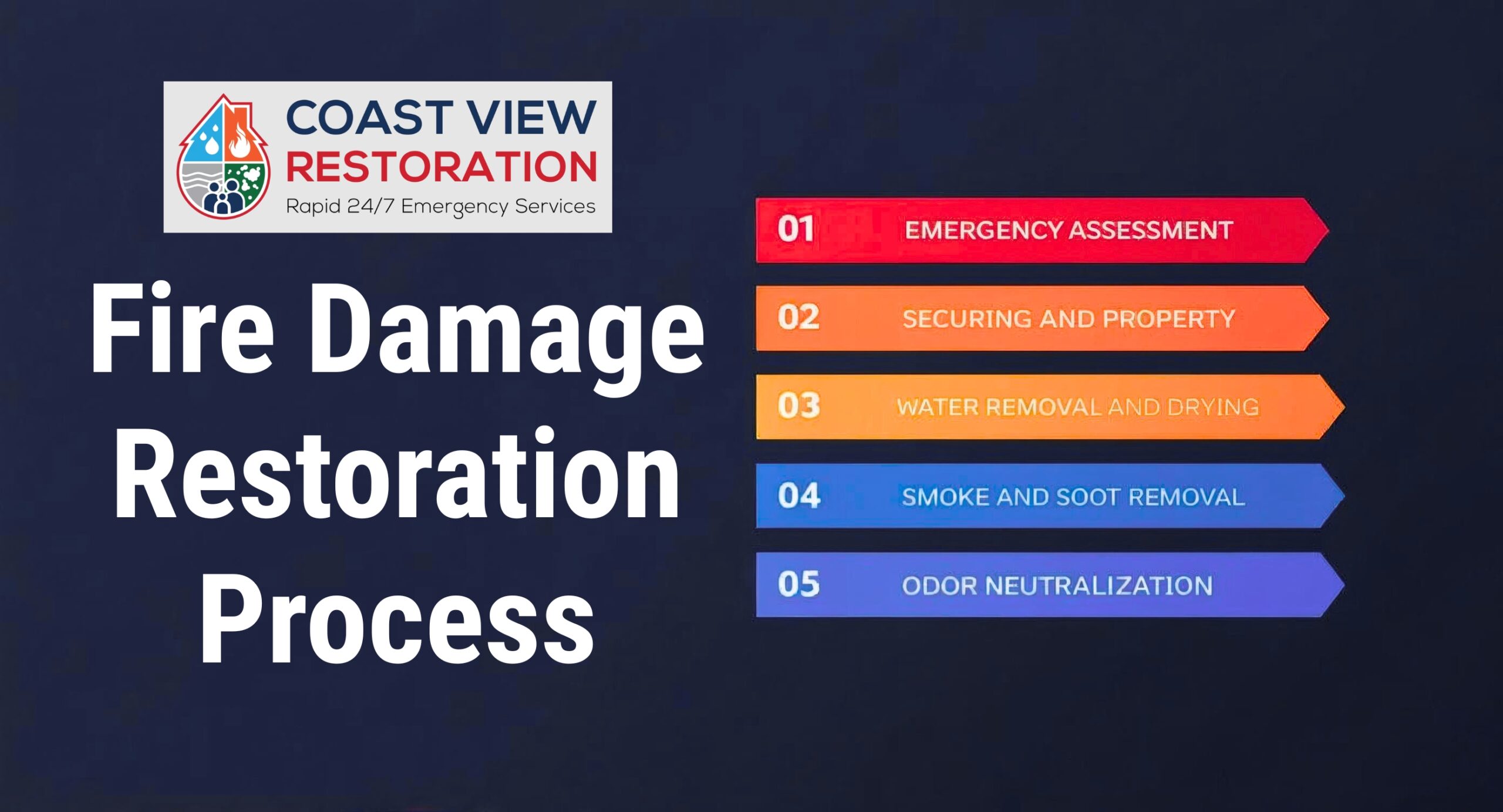
Fire Damage Restoration Process Overview
- Emergency assessment and safety inspection
- Property securing and stabilization
- Water removal and drying
- Smoke, soot, and ash removal
- Odor neutralization and sanitization
- Deep cleaning, content restoration, and full reconstruction
Each step builds on the last. Skipping or rushing any one of them creates lasting problems that are far more expensive to address later.
Step 1: Emergency Assessment and Safety Inspection
The fire damage restoration process begins with a thorough professional assessment, ideally completed within hours of the incident.
What happens during the initial assessment:
- Inspection of structural integrity to determine if the building is safe to enter
- Identification of fire, smoke, soot, water, and chemical damage throughout the property
- Evaluation of electrical, HVAC, and plumbing systems for hidden hazards
- Full damage documentation to support your insurance claim
- Development of a customized restoration plan based on the scope and severity of damage
At Coast View Plumbing & Restoration, our IICRC-certified technicians arrive within 45 minutes, 24 hours a day, 7 days a week, to begin this evaluation. The assessment gives our team a clear picture of the damage and allows us to prioritize the most urgent safety concerns before any cleanup begins. You also receive online access to your project file, including photos, progress updates, and timeline estimates, throughout the entire restoration process.
Step 2: Securing and Stabilizing the Property
Fires frequently compromise the exterior envelope of a building, leaving it open to weather, theft, and further structural deterioration. This step protects your investment while the restoration work gets underway.
Property stabilization may include:
- Emergency board-up of broken windows, compromised doors, and open walls
- Roof tarping to prevent water intrusion from rain or firefighting runoff
- Installation of temporary structural supports where load-bearing elements are weakened
- Perimeter securing to prevent unauthorized access to the damaged structure
Coast View Plumbing & Restoration handles all board-up and tarping services so that your property is protected from the moment we arrive. This work is often covered directly through your homeowner’s insurance policy. Our team works with all major carriers, including AAA, State Farm, Farmers, Allstate, and Liberty Mutual, to simplify that process for you.
Step 3: Water Removal and Drying
This is one of the most overlooked steps in fire damage restoration, but it is critical. Firefighting efforts introduce substantial amounts of water into a structure. If that water is not addressed quickly, secondary damage from mold growth and structural deterioration compounds the original fire damage significantly.
Water mitigation services include:
- Extraction of standing water using industrial-grade pumps and vacuums
- Deployment of high-capacity dehumidifiers and air movers throughout the structure
- Moisture mapping and monitoring using professional detection equipment
- Verification that all affected materials reach targeted dryness levels before proceeding
Our certified technicians use advanced moisture detection tools to set precise drying goals for every affected surface, including walls, floors, ceilings, and subfloor materials. Air quality is also monitored using hygrometers to ensure the space is drying efficiently and safely. This process typically takes a minimum of three days, though the scope of damage and the types of materials involved affect the exact timeline.
Step 4: Smoke, Soot, and Ash Removal
Smoke does not stay confined to the room where a fire originates. It travels through HVAC ducts, migrates into wall cavities, and settles onto every surface throughout the structure. Soot is chemically acidic and will cause permanent discoloration and material degradation if it is not removed promptly by a trained professional.
The fire damage cleanup process at this stage involves:
- Removing soot deposits from walls, ceilings, floors, and structural components
- Sodablasting surfaces for deep, thorough removal without causing further material damage
- Cleaning furniture, fixtures, appliances, and personal contents affected by residue
- Treating porous materials including drywall, insulation, and upholstery
- Cleaning dishes, cookware, and household items exposed to smoke and ash
This phase requires the right combination of chemical agents, application techniques, and equipment to be done correctly. Our IICRC-certified specialists at Coast View Plumbing & Restoration are trained in proper soot chemistry and use EPA-approved solutions to ensure effective, safe results on every surface type.
Step 5: Odor Neutralization and Air Quality Control
A persistent smoke smell is not just unpleasant. It is evidence that smoke particles and contaminants are still embedded in the materials and air of your home. Masking the odor with sprays or candles does not eliminate it at the source.
Professional odor removal methods include:
- HEPA air filtration to capture fine particulates from the air
- Thermal fogging to penetrate porous materials and neutralize deeply embedded odors
- Ozone treatment for severe or widespread odor situations
- Full HVAC system inspection and cleaning to prevent recirculation of contaminants
- Deodorization and sanitization of all affected surfaces
At Coast View Plumbing & Restoration, permanent odor removal is a standard part of our fire damage restoration process, not an add-on. We treat the source of the odor, not just the symptom, so that your property smells and feels like home again before we consider the job complete.
Step 6: Deep Cleaning, Content Restoration, and Reconstruction
Once contaminants are fully removed and air quality is restored, our team shifts focus to returning your property and your belongings to their pre-loss condition.
This final phase of the process includes:
- Deep cleaning and disinfection of all remaining surfaces
- Professional cleaning and restoration of salvageable clothing, textiles, and furnishings
- Specialized art restoration coordinated through our expert network
- Itemized documentation and inventory listing of all damaged or lost contents
- Careful packing and secure storage of undamaged items during the repair phase
- Drywall replacement, painting, flooring installation, cabinetry work, and trim repair
- Structural repairs and full reconstruction where required
With Coast View Plumbing & Restoration, you never have to coordinate multiple contractors or manage competing schedules. Our team manages the entire restoration from emergency response through the final walk-through. A dedicated Project Manager is assigned to your job from day one, handling communication, documentation, and direct billing to your insurance company, so you can focus on your family instead of the paperwork.
Why Professional Fire Restoration Matters
Attempting to handle fire damage cleanup without professional help, or delaying the start of restoration, creates risks that go well beyond cosmetic damage.
Skipping professional fire restoration can lead to:
- Ongoing health risks from soot particles, toxic residues, and poor indoor air quality
- Permanent staining and material degradation from prolonged acidic smoke exposure
- Mold growth resulting from untreated moisture left behind by firefighting efforts
- Structural weakening that becomes far more expensive to correct over time
- Voided or reduced insurance claims due to improper documentation or delays in action
IICRC-certified professionals bring the training, industry-grade equipment, and technical knowledge to address all of these risks correctly the first time. Acting quickly is the single most important thing a property owner can do after a fire.
Frequently Asked Questions About Fire Damage Restoration
How long does fire damage restoration take?
The timeline depends on the extent of the damage. Minor fire and smoke damage may be resolved in one to two weeks, while full reconstruction after a major structural fire can take several months. Your Project Manager at Coast View Plumbing & Restoration provides a detailed, realistic timeline after the initial assessment so you always know where things stand.
Does homeowner’s insurance cover fire damage restoration?
In most cases, yes. Standard homeowner’s insurance policies in California cover fire damage restoration, including smoke and soot cleanup, water damage from firefighting, and structural repairs. Coast View Plumbing & Restoration works directly with all major insurance carriers and provides thorough damage documentation to support your claim from start to finish.
Is it safe to stay in a fire-damaged home?
It is generally not advisable. Soot and smoke residue contain toxic compounds, and structural damage may create hidden hazards that are not visible to the untrained eye. Our team assesses safety as part of the initial inspection and clearly advises you on whether temporary relocation is the right step for your situation.
What types of fires does Coast View Plumbing & Restoration handle?
Our team is equipped to handle all fire types, including kitchen fires, electrical fires, oil and grease fires, propane fires, wildfire-related smoke and soot damage, and more. Whether the source was a small contained fire or a large structural event, we have the training and equipment to manage the full restoration process.
Serving Greater Los Angeles with 24/7 Fire Damage Restoration
Coast View Plumbing & Restoration provides IICRC-certified fire damage restoration services across Greater Los Angeles, including Lake Los Angeles, El Mirage, Adelanto, Victorville, Apple Valley, Hesperia, Lucerne Valley, San Bernardino, Pomona, Lytle Creek, Crestline, Claremont, Rancho Cucamonga, Fontana, and Colton.
When fire damage disrupts your life, trust Coast View Plumbing & Restoration to restore your property safely, efficiently, and completely. Contact us today to schedule your free assessment or call us now at (714) 769-6300.